
Supplementary Files
Keywords
Metapopulation
Mathematical Modeling
Basic Reproduction Number
How to Cite




Downloads
Societal impact
Abstract
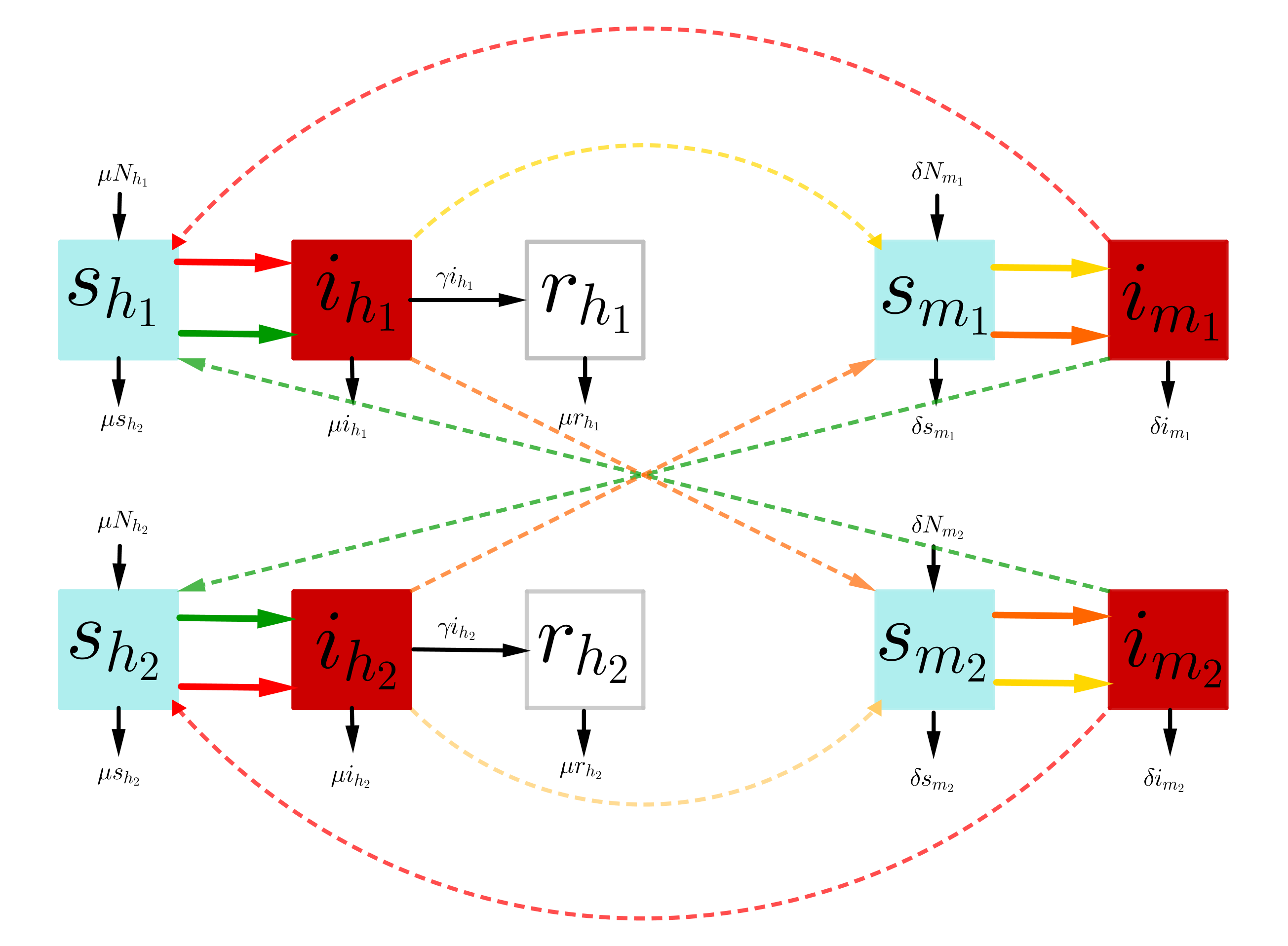
The growth of urban populations is increasing especially in areas with low resources. Such growth has been accompanied by deficient sanitation services and a lack of resources for storing water in adequate ways helping to the increase of the mosquito population and, consequently, dengue transmission. Dengue is a viral disease transmitted mainly by Aedes aegypti mosquitoes and is considered one of the greatest public health problems. The qualitative and quantitative analysis of the spread of this disease is important as it contributes to the design of plans for the prevention of an epidemic. Here, we present the analysis of a metapopulation model of the SIR-SI type representing the dynamics of dengue for two zones connected by the residence times of the human population in each one. Subsequently, we carried out the qualitative analysis of the model considering different connection scenarios between the two areas.
References
Arias, J., Martínez, H., Vasilieva, O. (2020). Biological and Chemical Control of Mosquito Population by Optimal Control Approach, Games, 11(4), 62.
Barrios, E., Lee, S., Vasilieva, O. (2018). Assessing the effects of daily commuting in two-patch dengue dynamics: A case study of Cali, Colombia. Journal of Theoretical Biology, 453, 14-39.
Castillo, C. & Brauer, F. (2001). Mathematical models in population biology and epidemiology, Volumen 40, Springer-Verlag, 2001. p. 411-425.
Chitnis, N., Hyman, JM., Cushing, J.M. (2008). Determining important para- meters in the spread of malaria through the sensitivity analysis of a mathematical model. Bulletin of mathematical biology, 70(5), 1272-1296.
Iggidr, A., Sallet, G., Souza, M. (2016). On the dynamics of a class of multi- group models for vector-borne diseases. Journal of Mathematical Analysis and Applications, 441(2), 723-743.
Jacquez, J. & Simon, C. (1993). Qualitative Theory of Compartmental Systems. SIAM Review, 35 (1), 43-79.
Lasluisa, D., Barrios, E., Vasilieva, O. (2019). Optimal strategies for dengue prevention and control during daily commuting between two residential areas. Processes, 7(4), 197.
Martcheva, M. (2015). An introduction to mathematical epidemiology (Vol. 61, pp. 9-31). New York: Springer.
MinSalud (2017), Plan nacional integral e interprogramático para la prevención, el control y la eliminación de las enfermedades infecciosas desatendidas 2013-2017. https://www.minsalud.gov.co/sites/rid/Lists/BibliotecaDigital/RIDE/VS/PP/ET/2013%2007%20Plan%20Interprogram%C3%A1tico%20EID.pdf
Padilla, J., Rojas, D., Saénz, R. (2012). Dengue en Colombia: Epidemiología de la reemergencia a la hiperendemia. Ministerio de Salud. p. 1-13.
Sepúlveda, L. (2015). Manejo óptimo y viable en modelos epidemiológicos de dengue. PhD tesis, Universie´ Paris-Est.
Smith, H. (1995). Monotone Dynamical Systems: an introduction to the theory of competitive and cooperative system, 41, American Mathematical Soc.
Travi, B. & Montoya, J. (1994). Manual de entomología médica para investigadores de América Latina, fundación CIDEIM.
Van den Driessche, P. & Watmough, J. (2002). Reproduction numbers and sub- threshold endemic equilibria for compartmental models of disease transmission. Mathematical biosciences, 180 (1), 29-48.
Velandia, M. L. & Castellanos, J. E. (2011). Virus del dengue: estructura y ciclo viral. Infectio, 15 (1), 33-43.

This work is licensed under a Creative Commons Attribution-NonCommercial-NoDerivatives 4.0 International License.
Copyright (c) 2022 Revista de la Academia Colombiana de Ciencias Exactas, Físicas y Naturales